Friday, 29 January 2010

Modernism of the last century

Controversial - even terrible - that was the reaction to this 1938 construction of a small row of three houses by the architect Erno Goldfinger.

Now they feature on the Hampstead Tourist Trail, not least because number 2 is now a National Trust property.

The James Bond creator Ian Flemming so hated the architecture and apparently these houses in particular that he named his principal villain Goldfinger thus placing the name into household status.

http://en.wikipedia.org/wiki/Ern%C5%91_Goldfinger

Goldfinger was a much celebrated Hungarian modernist architect, a generation on from the bauhaus movement, but also much known for his firery nature and character.

This house, at number 2 Willow Road, was Goldfinger's house of residence and opposite the house on the Preacher's Hill part of the Heath is a bench in memory of his son.

It's fair to say that even though the house is celebrated now, it was controversial with modernists at the time...

Erno passed away in 1987 and was cremated at Golders Green cemetary where his ashes were scattered.

Sunday, 17 January 2010

NW3's Embassy

One of the more significant bits of public space is here in NW3, at the end of Eton Avenue, just outside the Hampstead Theatre and the Central School of Speech and Drama.

The School has an amazing schedule of alumni and a proud track record of providing high quality education and training.

But the building itself has considerable history and hosts the Embassy Theatre.

The Theatre accomodates about 700 people and is a former Music Hall and dates essentially from 1928 when it was converted by architect Andrew Mather. It was previously Eton Avenue Hall from 1890 then Hampstead Conservatoire of Music.

During WWII the building was damaged and so saw an extensive refurbishment in 1945/1946.

The Theatre has a crucial place in the history of the development of modern Hampstead and Belsize in that it hosted the meetings of the AJR (Association of Jewsh refugees). This group initially met at 26 Belsize Park and then rented small premises at 279a Finchley Road before moving to 8 Fairfax Mansions.

On 27th May 1945 a meeting at the Embassy Theatre to mark the end of the wa saw 800 people in the theatre and 200 more outside and again on 3rd September the venue was used for the next stage of the AJRs work. A fascinating little part of the rich tapestry of NW3.

Wednesday, 13 January 2010

Blog-log Day 15 - a shared note of heritage for me

Regular readers of the blog will know that last year I undertook a personal trip to the concentration camp of Bergen-Belsen - my grandfather had been in the Liberation forces in 1945.

This morning I met with Social Affairs Minister Isaac Herzog in Jerusalem. Minister Herzog is a form of political Israeli royalty in that his father was Chaim Herzog (President of Israel 1983-1993), his grandfather was Rabbi Yitzhak HaLevi Herzog and his uncle was Abba Eban.

Minister Herzog is one of the few rising stars of the Labor Party in Israel - Labor is in a tough place there at the moment - but his charm, wit, speed of thought and personality makes him stand out. He is tipped for higher office and widely respected across the political sectrum in the Knesset and in the media.

We talked about a range of issues: my visit to Gaza, his father and the connection to Bergen-Belsen and the current political situation in the wider Middle East. It's clear to me that Herzog is someone who has a bigger view, he's an internationalist and has a real grasp of building relationships.

As a way of topping off an incredibly thought provoking trip to Israel, meeting and talking with Minister Herzog (nicknamed 'Buji') has done the trick.

Final postscript: I'm typing this at the airport - my final meeting was with Rachel Liel of the New Israel Fund to discuss some of the issues around civic society and development of Israel's democracy and giving the political system greater depth and relevance. Rachael gave me an insight into the beautiful town of Neve Shalom - Wahat Al-Salam. We then drove up to the town - it's just an amazing demonstration into the ideals of Israel and an illustration of how Jewish and Palestinian Arab citizens of Israel live and work together, and set in the most breath-taking scenario.

Right, back to north west London I think :-)

Tuesday, 12 January 2010

Blog-log Day 14 - Gaza

It's tricky to know where to start with this, and all I am really clear about is that my brain is about to burst, I have seen and heard so much.

But let me try and make a start and tell some of what I saw with pictures.

Today I went to Gaza, an early start to be there for the 8am crossing and a full day with UNRWA leaving Gaza at 3pm (it takes about an hour to get through security - not because it is busy but because it is a long and thorough process).

Can I also just say to all readers that this is very much written from what I saw - it's a complex set of experiences and the stories and accounts I heard need to be fully processed by me - not least by a night's sleep before being developed into firmer views - but let me try and give you an insight.

The first thing to say about the access is that it feels like an incredibly efficient but cold airport - but the other element I now understand is bar soldiers, just how few Israei's actually know what goes on within Gaza. I spent tonight having dinner with friends in Jerusalem and none of them have been to Gaza or the West Bank in at least the last 10 years - those that had been to Gaza went as soldiers (during service rather than during recent conflicts) and Ramallah or the West Bank was somewhere they had been to as much younger children.
I should add that I had absolutely no real or clear understanding of what to expect - it's the first time I had been to anything that might be described as a war zone, but all the reading of history didn't give me a clear image of what to expect.

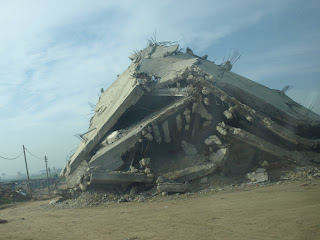
I was struck by the devastation in the 'buffer zone' - nothing was left standing - there are a few almost ironic features left - a tap in a field of ruins - but largely crumbled concrete and mangled metal from the building sturctures. The building construction time has rendered destroyed buildings near useless for re-using the materials.

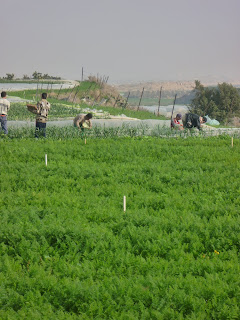
The second is that this all lies within what is clearly incredibly verdant landscape - it's clear that the north of the Gaza strip has/had the potential to be incredibly fertile agricultural land yet this is a community that relies on food vouchers from the UN - on a simplistic level - the contrast is just too stark to pass by without comment.
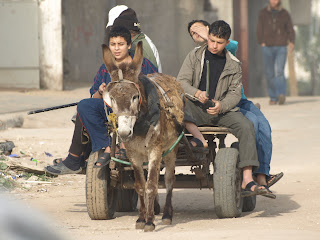
Next is the wider wider prosperity and potential of Gaza (and I only saw northern Gaza in the time I had). It was clear to me, and reflected in conversation with virtually everyone, that this is a community that is well educated, educationally ambitious for their young people, entrepenurial and innovative and dogged. But the war has set back such economic hopes and left a wake of distruction, mistrust and significant food and fuel poverty.

The blockade is having the effect of giving massive leverage over the local economy (if it can be called that) by the operators of the tunnels - the tunnels I now understand are not some determined small operation of a few parcels here and there - they are full scale passages enabling the illegal passage of fuel, building materials (cement, blocks etc) as well as commodities and food stuffs and inevitably arms and weapons. It's a full scale operation. The illegality of the operation is opposed by many of the traders and merchants of Gaza who see their business being undermined by Hamas.
Now I'm sure it is possible to get contrary opinions but some of the messages I heard were pretty clear and almost pleas to me at least (in no particular order):
- we (Palestinians) are not all terrorists, we are as much terrorised as Israel is.
- the vast majority of people here have no truck with extremism.
- there is little love for the British MP George Galloway and he is percieved by the people as stirring up anger and negative passions
- before the war there was strong and growing trade with Israel and that was good for trade, work, skills and opportunities
- the building destruction that has taken place has left an indelible mark as there are no rebuilding materials
- what is the next move/next stage if the "idiots" ( a direct quote) keep firing rockets: what do we "residents" do?

I think I'll pause there - I want to sleep further and think about what I saw and heard. Going was one of the best things I have done and I'm grateful to friends and contacts who made the links to enable me to get the permit and see something of it for myself and to the team who made my visit possible today.

Monday, 11 January 2010

Blog-log Day 13 - mathematicians and architects form a queue

The amazing thing about the Dome of the Rock is that when you look up/across at it from outside the Temple Mount you have no sense of the size, the scale and most of all the incredible use of space.

The next thing that strikes you is the amazing geometric architecture.

My father was always interested in ancient culture and art influences an often cited muslim art from the 7th/8th centuries on as being of incredible beauty and very advanced compared to other cultures.

Now I'm not claiming to know the dating of the decor of the Dome of the Rock - not least because it has gone through so many architectural era's and influences - not least for example the Stables of Solomon which are not of that era but are Crusader architecture, or the gold of the Dome itself which is very late 20th century!

But the mosaic's, the tiling, the geometry, the richness of colour, the complexity of the design, the mathematical fascination can only be marvelled at.

And for me, interested in ancient history - wandering around the Temple Mount constructed by Herod (much changed - not least by the demolitions of Titus and Hadrian, but the sense of place that it occupied remains) is a privilege and a joy.

Sunday, 10 January 2010

Blog-log day 12 - that dialogue over that fence over there

Two days ago I got the number 18 bus from East Jerusalem Bus Station, Nablus Road, and went to Ramallah - it was only brief and I hope to go back this week. But what I saw was full-on city - with an economy, with ambition, with potential. If it were (and this risks sounding trite) a part of London you would call on the council to take it's responsibilities seriously and crack on with the physical and economic regeneration that would move it forwards in leaps and bounds.

But whilst the government, people and army of Israel feels compelled to defend itself then the whole thing is depressed and maintained at a level that cannot and will not thrive.

The over-riding topic in Israel and on the West Bank in political conversations is that of security - and yet there is a curious double existence with the religious pilgrimages going on all around from Christians, Jews and Muslims.

This photograph of the security fence around the West Bank is taken from Mount Zion (Ironically I was visiting Oskar Schindlers tomb). It wasn't a clear day, but you can see the dominance of the Israeli security fence.

For a long time I have held the instinctive position that constructing walls between communities is wrong, that use of violence is wrong, that human rights are fundamental. Much of these 'western values' emerged from the wreckage of World War II and are principles that my grandfather's who fought in that war would recognise.

We tend to view the conflict between Israel and the Palestinians as a conflict that just needs sorting out. But here it is a battle for survival. There are groups, movements, armed individuals, groups and even countries that don't want Israel to exist. But the right for Israel to exist is now a permanent one and is now accepted in most Arab capitals.

So if you accept the right for Israel to exist, and then regret the existence of the walls and fence and the conflict you still have to handle the fundamental issue of security. And this it seems is where the mainstream debates in Europe and Israel differ. This week in one of the papers here, the former Israeli Ambassador to Germany described Israel and Europe of having two monologues instead of one dialogue and it feels to me like that's an accurate call.

There are countless community peace initiatives - in the UK, in Europe and even here in Israel - I saw the joint music centre in Ramallah - but it seems to me that these community led initiatives will count for nothing whilst the wider concerns over security exist. This is where Europe seems to part company with Israel. Whilst Europe's assumption is that that peace will come through trust, it feels like a pipe dream here. Neither side is going to stop it's current conduct. If anything it feels more likely that it will escalate. Israel will do anything (almost literally) to defend itself, it's people and it's existence - here on the ground I see and understand that. And the concerns over human rights, over atmospheric tension, over the effect on the next generation of Palestinians are put to one side.

The task for those of us who care about this is to reflect the concerns over the future of statehood - for both sides - understand the scale of passion on the need to defend yourself and security, security, security. Then and only then can a dialogue start that might enable real borders (not fences and walls) and then move into ordinary economic and human rights work. If this was easy it probably would have progressed - but it is not - and on the ground I guess I just understand the impossibility of the situation and the passions aroused by religion and borders and statehood. You end up trying to decide whether to try and make a difference or whether to walk away and try something else in another sphere of the world.

Saturday, 9 January 2010

Blog-log day 11 - into the Knesset, seeing for myself

So just how do you go about getting a balanced view of Israel and the conflict here in the Middle East?

I'm not sure there is a clear answer, but I'm here in Israel and there's no ducking some of the issues here.

So over the last 10 days I have been meeting up with residents (many of whom are not politically active), I have met with a number of interest groups, I've discussed domestic affairs like health and education and I have met with a range of politicians.

Going to the Knesset (The Israeli Parliament) was really interesting. I visited 15 years ago when I was President of the Students' Union at Nottingham University on a trip organised by the Union of Jewish Students. But this time my understanding of paliamentary democracy is a tad more attuned - and I've come under my own steam. I have met with a range of MKs (Knesset Members - equivalent to MPs) of many parties/factions and heard a wide spectrum of opinions and views.

I've been getting The Jerusalem Post and Ha'aretz newspapers each day (both in English) and they are at different ends of the Israeli political spectrum. I've been avidly reading and consuming news and conversation.

This weekend - my last few days here - I'll be in Ramallah on the West Bank and hopefully will get into Gaza as well - a mixture of seeing for myself as well as deepening my understanding. The walls, the Hamas rockets, the Israeli airstrike yesterday, the heightened sense of tension and even the Hamas in a stand-off against Egypt - all have a very different impact when they are taking place a few miles away from where you are staying.

One of the major concerns here is international opinion - not as some voice of conscience, but because of the role politicians play in shaping peace and aggression. So Barack Obama, not unsurprisingly, looms large. The general view, as far as I can ascertain it, is that at last America has a President capable of understanding complexities and nuances - that not everything is black and white - and nuance isn't a bland subtlety but a crucial part of effective diplomacy.

So the remaining issue to explain through this blog post is why I'm here - specifically. On that first visit 16 years ago I was totally taken by the heady mix of dust, history, religion and heat - my degree on Ancient History helped to instill me with an understanding of the age of the emotions and conflicts (it's useful knowing your Titus from your Hadrian!). I have a strong belief that even hard problems can be solved - it's years of playing chess, I think, that has forced that home.

So I'm visiting Israel with just 12 or so weeks before Gordon Brown finally goes to the polls. And I return to the UK (snow permitting!) charged up with enthusiam and passion - but also with understanding and empathy. Anyone can make a speech on a subject, but to speak from experience and knowledge is far more convincing. In Hampstead and Kilburn local residents want an MP who knows the issues, understands their concerns and who can engage in the dialogue.

Having renewed my links here in the Middle East, gained a better and fresher understanding and seeing much much more for myself I'm ready for the challenge and I'm willing to go further. I say to local residents in north west London - I know the issues, I understand your concerns and my views are drawn from personal experience and a preparedness to get out into the field and see it for myself.

Note: The trip is organised, planned and funded entirely by myself - I have had no official support from anyone in arranging appointments or meetings - it is all at my own initiative. I have been on the buses, met in the cafes, walked the markets - it has not been about chauffered cars or going where someone else wanted me to go. A snapshot, but I hope a valid one. The final clarification is that I'm neither jewish nor muslim, I have a faith but it is my own.