Wednesday, 31 December 2008

Hope in 2009?

This blog started on the back of a trip to Sierra Leone as part of the Westminster Foundation for Democracy (WFD) - and earlier this year I went back to West Africa to The Gambia.

It's a part of the world I find myself fascinated by - geography, climate, history - and the people I've met are just stunning, optimistic and charming in the extreme...

So the closing of 2008 and the opening of 2009 brings for me the chance to hope and pray for better living standards - Africa remains one of the great issues facing any developed nation, this year will be no different.

Monday, 29 December 2008

Lets get on our bikes this coming year

It's simple and it should epitomise London yet somehow the joy of cycling has not been embraced here yet.

This picture is from West End Lane of a bike scheme little rolled out across London. When I was in Spain(Valencia) and France (Paris) it's obvious that cycle schemes are supported and encouraged and they are not just tourist playthings.

The fact is this should be a cultural shift and I hope that this coming year will see Camden moving forward.

There has been a sudden rush of cycle lock up point across the boroughs of Brent and Camden - many of them in slightly illogical locations - but nevertheless welcome. It would be good if this process of making the committment to cycling can now be followed by an overt desire to engage with residents over this.

What could be done?
- public multi bike storage areas at all railway and tube stations (working with TfL and all user groups)
- all residents blocks to be offered bike lock-up points (eve of that means it effectively is located on private property)
- all area committees and public forums con-ordinated by the council to be on a constant hunt for suitable locations for cycle rack and bike lane facilities

There simple steps that would help instill a culture that encourages cycling...

Sunday, 28 December 2008

Let them eat bread?

Who would have thought that the culture of an area could be determined by bread, but it is true...

One of the more dominant features in the commercial development of Hampstead over the last two years has been the growth of bread shops.

It sounds flippant but this has enhanced an atmosphere which is welcoming - it has moved forward a cafe culture, has made the tourist options for Hampstead more visible (even in these winter months) and gives the perception of optimism and confidence in the local community.

When it comes to bread shops I say bring them in... Hampstead seems to be able to sustain them and the residents love them - there are few things better than fresh bread - and the visible effect is great.

Saturday, 27 December 2008

It this one of the best local buildings we have?

We're on Heath Street/Fitzjohn's Avenue and we have one of the most striking buildings in NW3 - now Munro House.

I've given some of the flavour of the early Victorian history of the buiolding, but would be keen to learn more from anyone out there who has an understanding of the more modern uses of the building... please post in the comment section or email me on ed.fordham@hampsteadandkilburn.org.uk

Here goes for some of the history...

The National Gazeteer for 1868 mentions the "Sailors' Orphan Home for girls, situated in Frognal"

Founded by a Major Powys the home provided domestic training for the orphans of sailors and also those childrens whose fathers were on active and foreign service. Part of the funding for the home came from the Regimental Scholarship Fund which sponsored children (girls) in the home.
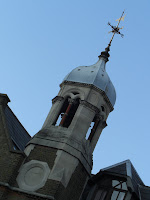
In 1878 the following description is listed in 'Hampstead: Rosslyn Hill', Old and New London: Volume 5'

" at the corner of Greenhill Road and Church Lane, a large and handsome brick building, with slightly projecting wings, gables, and a cupola turret. This is the Sailors' Orphan Girls' School and Home, which was originally established in 1829, in Frognal House, on the west side of the parish church.

"The present building was erected in 1869, from the designs of Mr. Ellis. The objects of the institution are the "maintenance, clothing, and education of orphan daughters of sailors and marines, and the providing of a home for them after leaving, when out of situations."

"The number of inmates is about one hundred, and the children look healthy and cheerful. Its annual income averages about £2,000. This institution was opened by Prince Arthur, now Duke of Connaught, in whose honour the road between it and the Greenhill is named Prince Arthur's Road."

By 1881 the home had had over 800 children through of whome 146 were orphans and 465 were fatherless.

The papers for the home are stored at London Metropolitan Archives
http://www.cityoflondon.gov.uk/Corporation/LGNL_Services/Leisure_and_culture/Records_and_archives/

Reference:
A/FWA/C/D/122/001Sailors' Orphan Girls School and Home, later Royal Sailors Daughters School and Home (case 7313 or 4/1881):
correspondence and papers
Creation dates: 1881-1946
Scope and Content
116 Fitzjohns Avenue Hampstead

Friday, 26 December 2008

Swiss Cottage and the sculpture

This is one of those things that you walk past and don't really notice - I know I have passed it on literally hundreds of occasions - so I stopped and had a read.

The inscription reads:
"The Hampstead Figure
F E McWilliam 1964"

I'm not sure that I appreciated that it is in fact an abstracted female figure on a plinth!

So I undertook some digging and discovered that F.E. McWilliam (1909-1992) was an Irish sculptor from Banbridge, County Down.

A student at Belfast School of Art and Slade School of Fine Art in London. Intially he studied painting by soon turned to sculpture.

At fiurst he sculpted in wood and drew heavily on African art with primitive and simple forms. He then moved to surrealist forms and drew on the notion of exploring fragments and a sarcasm and a wit that was sometimes shocking.

His commisions are many and include:
  • The Four Seasons for the Festival of Britain, 1951
  • Father Courage for Kent University at Canterbury, New Zealand, 1960
  • Hampstead Figure at Swiss Cottage, London, 1964.


He saw active service in India in the Second World War but returned to teach at Chelsea School of Art and at the Slade. He joined the London Group in 1949, RBA in 1950 and was elected an RA associate in 1959, resigning four years later.

His work is represented in many major national collections including the Tate Gallery, London and Museum of Modern Art, New York. Retrospectives held at Arts Council of Northern Ireland, 1981 and Tate Gallery, 1989. Lived and worked in London.


It's worth noting that this is listed:

Location: (East side)
'The Hampstead Figure', Sculpture to north of Swiss Cottage LibraryStreet: Avenue Road
Grade: II
Reference No: 798-1-1007461
Date of listing: Aug 6 1999 12:00AM

Description:
Reclining abstracted female figure on plinth. 1964 by F E McWilliam. Bronze. Inscribed 'The Hampstead Figure, 1964' and signed. Commissioned as part of the group of civic buildings for the borough of Hampstead by Sir Basil Spence, Bonnington and Collins, with which it forms a close and complementery grouping. F E McWilliam (1909-92) was a noted and prolific British sculpture, whose public works have not survived well.

Wednesday, 24 December 2008

Wow, these bits of architecture just litter the street...

It is pretty impressive, but the briefest stroll down Eton Avenue, NW3 is a joyful wander through architectural excellence.

There is something about the work that is almost casual - I think it derives from the fact that almost every building is adorned with the details and brickwork sufficient to please any home - unless you want minimalism.

Each doorway is different, each architrave has it's own distinction - it's as though each individual building has it's own specification.

Perhaps that was precisely what happened - you agreed to buy a house, a plot and you then sat down and from a catalogue you picked the brick work and style you wanted?
http://474towin.blogspot.com/2008/12/many-faces-of-cricklewood.html

I have noticed that the same builders were often used in the local area and in fact the architect for Eton Avenue in Belsize is also the architect for Lyndhurst Gardens in Hampstead.

Many are dated, have signature plaques, have shiedls and coats of arms as well as small features of bronze, copper and moulded brick work.

It's truly remarkable and almost worthy of it's own detailed street study.

Much has been written about the development of the local area, but I'm not aware of a survey of each building. No doubt where there is listing, and we are after all in a conservation area, there is a record - but are the specific features captured, appreciated and catalogued?

I realise that it's not just the brickwork - but also the clever use of light, glass and the number of almost elevated conservatories really adds to the sense of spece in what is a very developed and built up area.

I've posted on the genre and the impact before:
http://474towin.blogspot.com/2008/06/englands-lane-to-hampstead-theatre.html

I'm told that part of the archtectural development of the area was driven by the desire to achieve quality in the light of the Eton College connections - this is simply reflected in the naming of the roads of the area, but I'm not aware of direct eveidence linking the architecture to this heritage:
Eton Road
Eton Avenue
Kings Colleg Road
Merton Rise
Eton College Road
Fellows Road

Tuesday, 23 December 2008

Tesco's hand-me-downs sound a tad hollow

For months the residents of South Hampstead and Swiss Cottage have been plagued by an ongoing battle with Tesco over the threatened planning application at the Loudoun Road roundabout for a new store. That battle is now drawing to close as there is a planning application aprroved and they have a licence - but there are conditions attached and they need to be respected.

For some people this is a real and immediate issue as they quite literally live above it, but now the building works are in full steam.

I noticed yesterday as I went past the sign up saying that Tesco wants to work with the community.

It's a great sign and a great claim, but it is now incumbent for them to actually prove that this isn't just a coporate hand-me-down and is in fact a real commitment.

One of the things they could do is have a real and genuine dialogue with the residents of Sheridan Court, they could make some reference to the previous uses of the site by saving for example the pub sign from the Britannia Pub that stood there until a week or so ago, and they could work with other local traders to ensure that in opening their shop they don't create a major hole in the immediately local market.

There could even by a discussion with TfL about having some refurbishment o the South Hampstead Railway station and providing some community notice boards and enhancements there...

Come on Tesco, don't play words with the community - be proactive and prove your worth.

To date it's been a bit lacking, perhaps this is the time to turn over a new leaf for South Hampstead.