
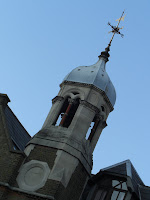
We're on Heath Street/Fitzjohn's Avenue and we have one of the most striking buildings in NW3 - now Munro House.
I've given some of the flavour of the early Victorian history of the buiolding, but would be keen to learn more from anyone out there who has an understanding of the more modern uses of the building... please post in the comment section or email me on
ed.fordham@hampsteadandkilburn.org.ukHere goes for some of the history...
The National Gazeteer for 1868 mentions the "Sailors' Orphan Home for girls, situated in Frognal"
Founded by a Major Powys the home provided domestic training for the orphans of sailors and also those childrens whose fathers were on active and foreign service. Part of the funding for the home came from the Regimental Scholarship Fund which sponsored children (girls) in the home.
In 1878 the following description is listed in 'Hampstead: Rosslyn Hill', Old and New London: Volume 5'
" at the corner of Greenhill Road and Church Lane, a large and handsome brick building, with slightly projecting wings, gables, and a cupola turret. This is the Sailors' Orphan Girls' School and Home, which was originally established in 1829, in Frognal House, on the west side of the parish church.
"The present building was erected in 1869, from the designs of Mr. Ellis. The objects of the institution are the "maintenance, clothing, and education of orphan daughters of sailors and marines, and the providing of a home for them after leaving, when out of situations."
"The number of inmates is about one hundred, and the children look healthy and cheerful. Its annual income averages about £2,000. This institution was opened by Prince Arthur, now Duke of Connaught, in whose honour the road between it and the Greenhill is named Prince Arthur's Road."


By 1881 the home had had over 800 children through of whome 146 were orphans and 465 were fatherless.
The papers for the home are stored at London Metropolitan Archives
http://www.cityoflondon.gov.uk/Corporation/LGNL_Services/Leisure_and_culture/Records_and_archives/Reference:
A/FWA/C/D/122/001Sailors' Orphan Girls School and Home, later Royal Sailors Daughters School and Home (case 7313 or 4/1881):
correspondence and papers
Creation dates: 1881-1946
Scope and Content
116 Fitzjohns Avenue Hampstead
 The statue to Sigmund Freud is a real delight - interesting, poise, character and similarity - all captured in this bronze just at the bottom of Fitzjohn's Avenue and the start of Belsize Lane.
  It's on the land associated with the Tavistock NHS clinic


 Now I also know these houses are large and therefore were the domain of the rich and wealthy, but nonetheless it is reflective of the arts and crafts tradition - not only was this a commitment to a more rustic pride and tradition, but it was an appreciation of quality and a lifestyle that aspired to be the best for everyone.


