Showing posts with label Heath Street. Show all posts

Thursday, 8 April 2010

The Pond like you have never seen it...

Whitestone Pond is something of a local legend so it's great to see the level of care and attention being lavished upon it by a joint repair venture by the City of London and Camden Council.

These snaps taken this weekend just gone are of the pond being worked upon as you will soon never see it again.

The pond and it's environs have an incredibly special place in the heart of Hampstead - once known as the cockney seaside we have at last restored the donkey rides and begun to re-create the victorian funfair atmosphere...

http://474towin.blogspot.com/2008/10/where-is-that-white-stone-hidden.html

Originally it was called the horse pond and was the place where people coming over the heath and about to go down into Hampstead would run their horse and cart through the pond to clean the mud off the hooves and wheels to stop slipping when going down the steep Heath Street.

Sunday, 13 September 2009

Gail's Party livening up the street!

Yes, it's the Hampstead Gail's street party - a great riot of colour, smells and tastes - lots of breads, cakes, sausage, homegrown direct marketed products.

It was yesterday (Saturday) in Hampstead (just off the High Street and Heath Street) and was absolutely packed.

Lots of children, families, older folks as well as the traders and performers.

A huge well done and thanks to Ran the owner of Gail's - I'm absolutely sure that small scale festivals such as this add to the atmosphere of a community like this and only for the better.

Once again thanks.

Wednesday, 28 January 2009

A brief indulgence please....

I try and focus this blog on local historical, architectural and curious features of interest - it's not often I give way to my own very specific preference - besides the genre of the content. :-)

But Louis' cafe - one in Heath Street, Hampstead, and the other on Finchley Road, Swiss Cottage, are great institutions... This is the Hampstead branch.

You haven't been? Get there now!

My other regular haunt is of course the inimitable Wet Fish Cafe on West End Lane - we love it, love it, love it...

http://474towin.blogspot.com/2008/06/wet-fish-cafe-is-just-best.html

Wednesday, 14 January 2009

As design standards go this is pretty good

I've sat through a presentation this morning of a proposed design for a new building in the local area - frankly it was flat, disappointing and timid.

It did nothing to reflect the diversity of the community, the rich heritage of the local area...

So I dipped into my photo file to see something by way of contrast - it wasn't difficult.

Here is the former Horse and Groom pub in Heath Street, Hampstead - tall, impressive, glamorous and bold and adding to the local architecture.

Sure I understand that such a build now might be condemned by local groups and organisations as being too excessive, but the reality is such design courage seems lacking. It's not a premise that designs that shock are wrong - it's a broader issue over design and quality. I'm not talking aesthetic quality but more generally around building materials, built to last and reflecting a community.

When this was built Hampstead was quite literally on the up - buildings were designed to be impressive, intimidiating and designed to show the brazen confidence of the business community.

Ah for such an approach now...

One website reports todays pub in the following way: Closed - converted into Chinese restaurant - then into Room 68 - an upmarket free house/bar restaurant. That didn't last, it's now a French restaurant called J'aime. [Last update: 17/02/2007]

Sunday, 28 December 2008

Let them eat bread?

Who would have thought that the culture of an area could be determined by bread, but it is true...

One of the more dominant features in the commercial development of Hampstead over the last two years has been the growth of bread shops.

It sounds flippant but this has enhanced an atmosphere which is welcoming - it has moved forward a cafe culture, has made the tourist options for Hampstead more visible (even in these winter months) and gives the perception of optimism and confidence in the local community.

When it comes to bread shops I say bring them in... Hampstead seems to be able to sustain them and the residents love them - there are few things better than fresh bread - and the visible effect is great.

Saturday, 27 December 2008

It this one of the best local buildings we have?

We're on Heath Street/Fitzjohn's Avenue and we have one of the most striking buildings in NW3 - now Munro House.

I've given some of the flavour of the early Victorian history of the buiolding, but would be keen to learn more from anyone out there who has an understanding of the more modern uses of the building... please post in the comment section or email me on ed.fordham@hampsteadandkilburn.org.uk

Here goes for some of the history...

The National Gazeteer for 1868 mentions the "Sailors' Orphan Home for girls, situated in Frognal"

Founded by a Major Powys the home provided domestic training for the orphans of sailors and also those childrens whose fathers were on active and foreign service. Part of the funding for the home came from the Regimental Scholarship Fund which sponsored children (girls) in the home.
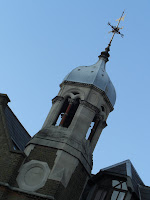
In 1878 the following description is listed in 'Hampstead: Rosslyn Hill', Old and New London: Volume 5'

" at the corner of Greenhill Road and Church Lane, a large and handsome brick building, with slightly projecting wings, gables, and a cupola turret. This is the Sailors' Orphan Girls' School and Home, which was originally established in 1829, in Frognal House, on the west side of the parish church.

"The present building was erected in 1869, from the designs of Mr. Ellis. The objects of the institution are the "maintenance, clothing, and education of orphan daughters of sailors and marines, and the providing of a home for them after leaving, when out of situations."

"The number of inmates is about one hundred, and the children look healthy and cheerful. Its annual income averages about £2,000. This institution was opened by Prince Arthur, now Duke of Connaught, in whose honour the road between it and the Greenhill is named Prince Arthur's Road."

By 1881 the home had had over 800 children through of whome 146 were orphans and 465 were fatherless.

The papers for the home are stored at London Metropolitan Archives
http://www.cityoflondon.gov.uk/Corporation/LGNL_Services/Leisure_and_culture/Records_and_archives/

Reference:
A/FWA/C/D/122/001Sailors' Orphan Girls School and Home, later Royal Sailors Daughters School and Home (case 7313 or 4/1881):
correspondence and papers
Creation dates: 1881-1946
Scope and Content
116 Fitzjohns Avenue Hampstead

Tuesday, 21 October 2008

Donkey ride for you too?

It's a direct guessing game - it's just for fun - there are no prizes - but which of these is 1908 and which is a current day snap...? :-)

http://www.london2012.com/get-involved/cultural-olympiad/events/807.php

For those that don't know Whitestone Pond is at the top of Hampstead High Street / Heath Street.

It's claimed to be the highest point of London - it's certainly high - but there is some argument over the claim...

But the Whitestone Pond site is a really pretty, very significant local feature. It has bags of historical significance - it was the site of one of the 1588 armada beacons, it was the location of visits to the area from Dickens, Thackeray, Crabbe and Constable often sat here to paint.

http://474towin.blogspot.com/2008/02/blue-plaque-for-george-crabbe-in.html

http://474towin.blogspot.com/2008/09/high-on-bleak-hampsteads-swarthy-moor.html

The sepia photograph is one of the postcards from my personal collection of the local area and you can see the horse carts going through the water in the background. The pond had two effects - the first was to water and refresh the horses that had come up/down the hill and second it cleaned the wheels of mud to stop slippage esp. if going down the hill.

There is much much more to follow on this topic and I am especially keen to ensure that the forthcoming refurbishment of the area - much needed and supported by both Camden, the City of London and funded partially by the section 106 money of Heath House - ensure that it is heritage refurbishment than another traffic improvement scheme.

It's great living round here with stuff like this in the vicinity...

Ed

Saturday, 13 September 2008

The lanes of Hampstead

Okay, okay - they are not lanes but one of the most charming features of Hampstead are the number of lanes - often small old, even medieval.

I've taken to capturing them on camera cos their charm and historical insight.

Spring Path indeed refers to the old and ancient spring - one of the tributaries of the Fleet river that runs from the Heath and Shepherd's Walk was one of the paths that was used for driving sheep onto and from the Heath.

In fact I have a postcard from about 1896/98 of sheep grazing on the heath...

And then there is this small lane off of Heath Street - about half way up on the left - if I recall correctly it leads up and onto Holly Bush Steps and thence the Holly Bush Pub.

There are so many sdo of which refer to the name of the old trading company that was there - Stanford Close, some refer to the residents - Golden Yard - and others are less clear - Bird In Hand Yard (presumably an old pub?).

I'm sure there is a really good sunday walk about the unknown lanes and alleys of Hampstead - one for me to ponder on over the weekend as the trickiest bit is putting otgether the map - it's one of those occasions where your knowledge is in your head but drafting the map would be pesky and I'm not a cartographer.

Wednesday, 10 September 2008

The importance of the lamp

Lighting in the local community is one of things that is most recent in the western world that has made the biggest difference.

Usually it has been used to extend the working day (aaaghhh) but in fact as can be seen here it also adds to the sense of quality and atmosphere in a community. These lamps are all from Hampstead.

The main one on the right is from the restaurant on the corner of Church Row and Heath Street - and it's a great example of quality workmanship.

Within local government, in communities and local opinion formers there is an ongoing desire to maintain and enhance an area through quality fixtures and fittings. These lights are part of that.

Of course lighting as i say has come on a pace but it's not a thing of just recent times - the first real issue at which there was a demand for lighting Hampstead was in 1774 whereby lighting was identified as a means of countering robbery - this was enhanced by an association in 1789 and by 1828 the area had day and night patrols. This wasn't a small operation, the record shows a paid superintendent, 17 watchmen, and 8 patrols and further 17 watchboxes were provided

So it's especially good to see this string of lamps in Perrin's Lane - not only are they all in one street, but the fact that they are different adds real character.

I realised taking the picture that it's this issue much spoken of about creating 'a sense of place' - an ownership and pride.

Just to finish the story of the arrival of gas and then electric lighting in hampstead the pace of change was great:
- The Local Act of 1774 allowed commissioners to levy a lighting rate for the town
- Oil lamps used were quite sparsely positioned, many larger houses still provided their own lights
- In 1823 the Imperial Gas Light & Coke Co. received permission to lay pipes and gas lamps were provided, beginning in High and Heath streets
- By 1853 Hampstead Borough had 405 lamps
- In 1872 Imperial Gas supplied 935 lamps and the Western Gas Light Co. 126 lamps.

Legislation then enabled private companies to get Board of Trade orders which meant they were bringing electricity to the parish in 1883 and again in 1892. However, The Vestry of Hampstead were opposed but persuaded that it would be profitable to build and run its own electricity undertaking, opened a power station in West Hampstead in 1894, in order to supply both private consumers and the public street lamps.

Friday, 27 June 2008

Come on down to the Kit Cat Club

How much plotting occurred here during the early 18th century?

This small house hidden away off Heath Street has puzzled me for a while..

So I learn that either this house or the pub that was called The Upper Flask (just up the road where St mary's now stands) was the gathering spot for a cluster of Whig grandees.

It should be noted that this was not a smoke cabal - it was a summer garden gathering where converse and social intercourse were the norm...

The political context is fresh from the Jacobite rebellions and are rooted in the succession in 1714 of Prince Elector George Louis of Hanover as King George I and appointment of the Whigs who became dominant from this date through to 1760.

The Kit Cat club's dissolution was about 1720 (probably after Walpole became Prime Minister) and the Upper Flask continued as a tavern. In 1750 it became private house known as the Upper Bowling Green House, and in 1920 this was demolished for Queen Mary's maternity hospital.

Friday, 13 June 2008

The days of a look out tower.

It is said that Hampstead tube station is the deepest tube station in London - it may or may not be true, but one of the reasons for the depth is that it runs under the top of the hill.
And just over the road, literally, is the corner of Holly Hill and Heath Street at the top of hampstead High Street and on that junction is the old Fire Station.
When you look at it it's hard to realise that it was the fire station and in the relatively recent past - but sure as eggs is eggs, it was. The idea of having a look-out on top of the building seems such an odd concept but when you look at the architecture it's obvious really.
Now it's just flats and the nationwide Building Society and of course a clock tower that doesn;t keep accurrate time!
The building was designed by one George Vulliamy and was opened in 1874. The site had been previously used for the police station.
However, the world of Fire Station locations had to move to keep up with the fast expanding population centres and the need for watch towers subsided.
So it was that in 1901 West Hampstead Station on West End Lane was opened, in 1915 the Belsize Station in Lancaster Grove opened and by 1923 Hampstead Station was closed.

Sunday, 3 February 2008

One of the best wall adverts yet?

Staring me straight in the face in my own stomping ground of Hampstead - there was one of the best wall mural adverts surviving.

It's on Heath Street, just the junction of Church Row, and is a superb example of the type.

There's not really much else to say, but to admire and appreciate.

Estblished 1746
Chas B
king
Estate
Agent
Decorator
Gas
Hot Water
and
Sanitary
Engineer

http://474towin.blogspot.com/2008/01/more-advertising-walls-by-popular.html